

The acronym ALGARIKON is a mixture of ´algae´ and ´agarikon´. The last word comes from Greek and it might derived from a Scythian tribe named Agari. These people were well versed in the use of medicinal plants and often included in their remedies a fungus called ´agaricum´. Probably, the scientific name of the white button mushroom, Agaricus bisporus, came from this fact.
The prefix ´alga´ refers to the invasive algae of Mar Menor. This research project is called ´Algarikon´ because its main objective is to use edible mushrooms as a ´remedy´ to reduce the negative impact on the Mar Menor environment that the accumulation of algal wracks provokes in its shores contributing to its eutrophication.
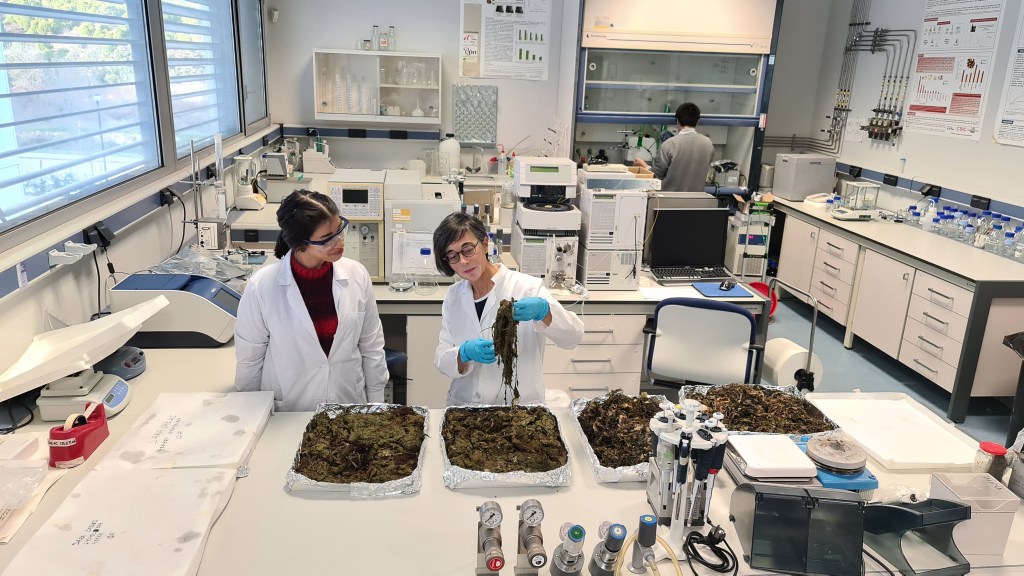
Algarikon is financed by the Ministry of Science and Innovation and the European Union as part of the Transformation and Resilience Recovery Plan. It is divided into three subprojects with references: TED2021-129591B-C31, TED2021-129591A-C32, TED2021-129591B-C33.
The project is led by UAM (Universidad Autónoma de Madrid) contributing with three participating groups: the Departmental Section of Food Sciences; the Department of Geology and Geochemistry and, the Department of Agricultural Chemistry and Bromatology. In addition, other research centers also participate, such as CTICH (Centro Tecnológico de Investigación del champiñón) from La Rioja; CIEMAT (Centro de Investigaciones Energéticas, Medioambientales y Tecnológicas) from Madrid and IMIDA (Instituto Murciano de Investigación y Desarrollo Agrario y Alimentario) from Murcia together with some Murcian SMEs.
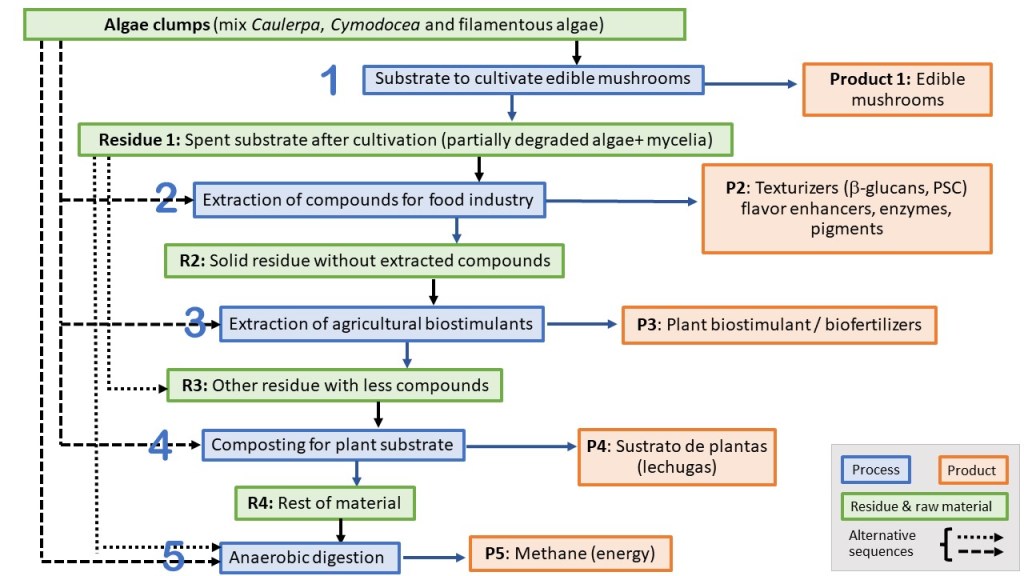
Outline of the intended process that will be optimized during the development of Algarikon Project. A sequential method to obtain useful products until their complete utilization.
The algae accumulated on Mar Menor shore will be tested as a substrate to cultivate edible mushrooms (1). The algal wracks, before and after the fungal growth, will be submitted to extractions to obtain compounds with food applications (additives, supplements, flavorings, etc.) using environmentally friendly technologies (2). The extracts obtained from the waste derived from the algae and after the mushroom cultivation, will be tested as biostimulants and biofertilizers for plants and organic amendments for contaminated soils (3). The potential of the residue as a plant substrate will also be investigated in greenhouses using lettuce as a model (4). Finally, tests will be carried out to study the potential of all these wastes as raw materials for fermentation in anaerobic digestors to produce methane and to calculate its energy efficiency (5).

However, the order of the 5 processes could be modified depending on the results, therefore other alternative sequences (—-) and even independent processes will be tested.
Algarikon-zero
Thanks to the ¨Mares circulares¨ prize granted to the Start-up, the Algarikon valorization process will be extended to reach almost circular economy by adding 2 new steps: to re-introduce the digestate after the methanization process as supplement to cultivate edible mushrooms (6) and as biofertilizers for lettuce production (7).
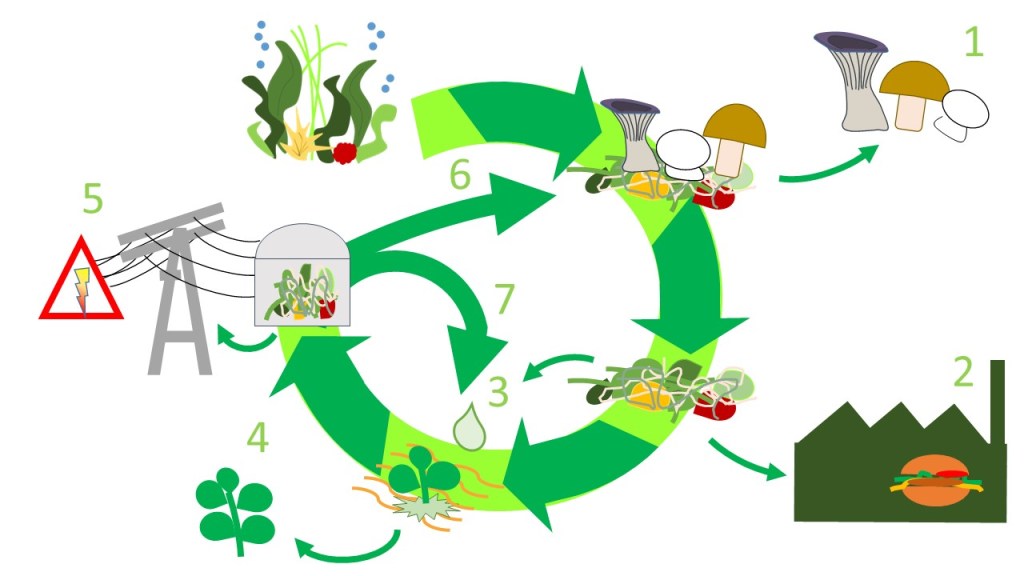
This new extension will be called Algarikon-zero and will last for an extra year.
 Proyecto Algarikon