

The first project, source of the initial scientific evidences and base for following up projects, used as acronym «ALGARIKON,» a combination of «alga» and «agarikon.» The latter word comes from Greek and appears to be originated from a Scythian tribe called the Agari, medicine men who were well-versed in the use of medicinal plants and frequently included a mushroom called «agaricum» in their remedies. This name is likely to be used as scientific name for the White buttom mushroom: Agaricus bisporus. The prefix «alga» refers to the invasive algae of the Mar Menor lagoon.
Algarikon
This research project was then called “Algarikon”, because its objective was to use edible mushrooms as a “remedy” to reduce the negative environmental impact of the algae wracks from Mar Menor lagoon that accumulate on its shore as a result of eutrophication.
The algae accumulated on Mar Menor shore were tested as a substrate to cultivate edible mushrooms (1). The algal wracks, before and after the fungal growth, were submitted to extractions to obtain compounds with food applications (additives, supplements, flavorings, etc.) using environmentally friendly technologies (2). The extracts obtained from the waste derived from the algae and after the mushroom cultivation, were tested as biostimulants and biofertilizers for plants and organic amendments for agricultural and contaminated soils (3). The potential of the residue as a plant substrate was also investigated in greenhouses using lettuce as a model (4). Finally, tests were carried out to study the potential of all these wastes as raw materials for fermentation in anaerobic digestors to produce methane and to calculate its energy efficiency (5).

Algarikon was financed by the Ministry of Science and Innovation and the European Union as part of the Transformation and Resilience Recovery Plan. It was divided into three subprojects with references: TED2021-129591B-C31, TED2021-129591A-C32, TED2021-129591B-C33.
The project was led by UAM (Universidad Autónoma de Madrid) contributing with three participating groups: the Departmental Section of Food Sciences; the Department of Geology and Geochemistry and, the Department of Agricultural Chemistry and Bromatology. In addition, other research centers also participated, such as CTICH (Centro Tecnológico de Investigación del champiñón) from La Rioja; CIEMAT (Centro de Investigaciones Energéticas, Medioambientales y Tecnológicas) from Madrid and IMIDA (Instituto Murciano de Investigación y Desarrollo Agrario y Alimentario) from Murcia together with some Murcian SMEs.
The results were quite promising so further scaling up methods were explored as an attempt to implement them in the real world.
Algarikon-zero
Thanks to the ¨Mares circulares¨ prize granted to the Start-up, the Algarikon valorization process was extended to reach a method for circular economy by adding 2 new steps: to re-introduce the digestate after the methanization process as supplement to cultivate edible mushrooms (6) and as biofertilizers for lettuce production (7). Once more, results showed a high potential so the created start-up looked for funding to increase the TRL of those task with lower level.
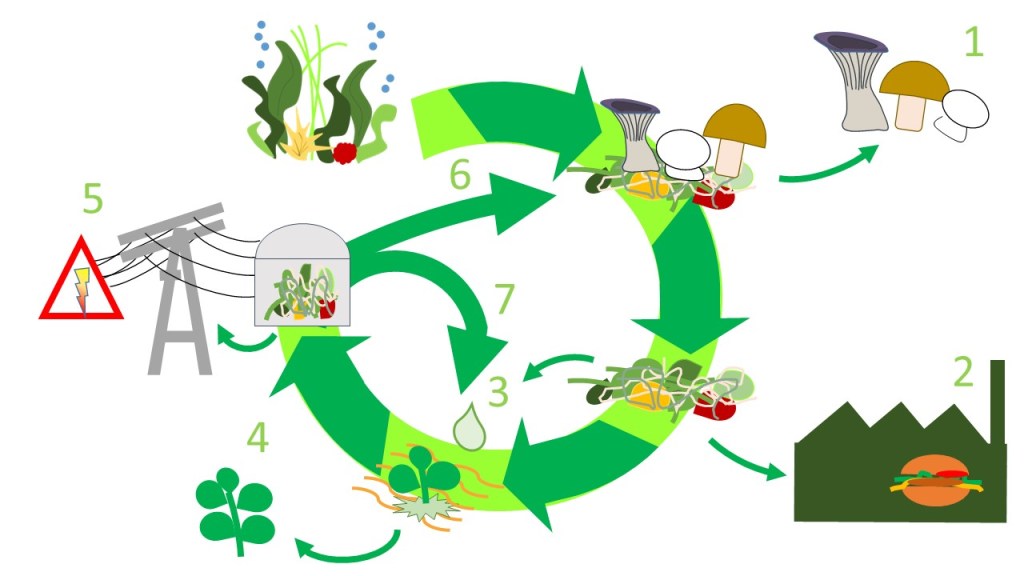
This new extension was called Algarikon-zero since its objective was to close the cycle to get «zero» residue.
CH4Marine
This new project is currently being developed by the Start-up and was financed by the Regional Government of Madrid (Comunidad de Madrid). Its main objective is to increase the scale of the patented biomethanization process using seawater (5).
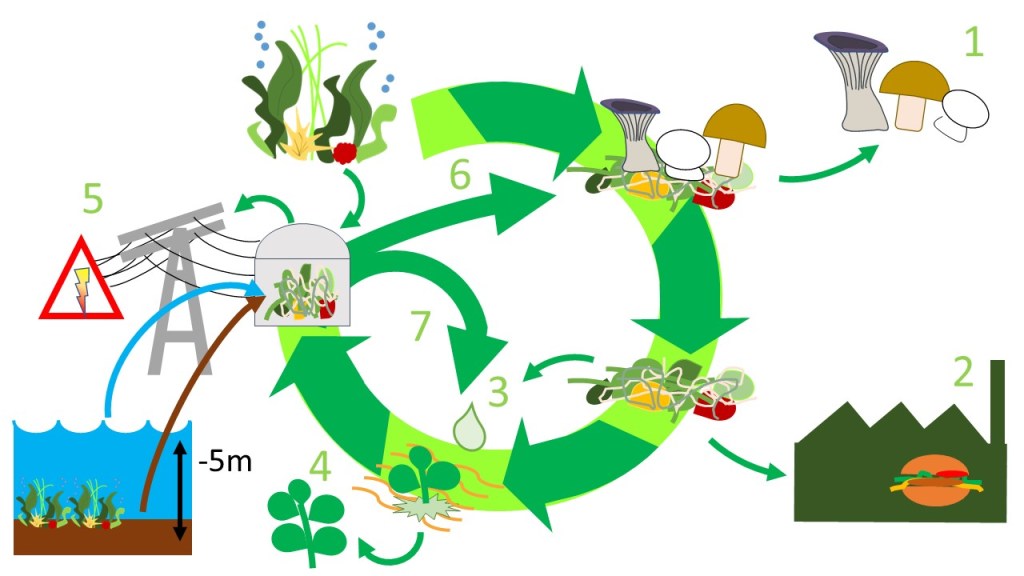
The initial results are also promising, so we have now started with the up-scaling and continuous-system testing.

